
You don’t need the biceps of a legendary lumberjack to sink steel into wood; in fact, brute force is usually your biggest enemy in the lane. Many people worry they aren’t strong enough to compete, but the truth is that axe throwing for beginners is all about rhythm, finesse, and a bit of swagger. It is natural to feel a little anxious about a heavy blade or the fear of a bounce-back. We realize that the first time you step up to the target, you want to feel safe and capable rather than confused by your grip.
We are here to turn that hesitation into pure adrenaline. This guide will help you master the art of the axe with pro-approved techniques, vital safety tips, and step-by-step guidance for your first session. You will learn how to find your centre, lock in your stance, and release with total control. We are covering everything from basic rules to expert secrets so you can walk into your next group event ready to stick your first bullseye. Grab your gear. It is time to find your target.
Key Takeaways
- Experience the visceral thrill of the lane and realize that success depends on rhythm rather than brute strength.
- Lock in the two-handed overhead throw, the most stable technique for axe throwing for beginners, to guarantee a satisfying thud.
- Troubleshoot your technique by learning to diagnose over-rotation and eliminate the “wrist flick” for a cleaner release.
- Master the official 2026 scoring zones and safety rules so you can step into the lane with total confidence.
Axe Throwing 101: What to Expect at Your First Session
Step through the doors and the first thing you will notice is the vibe. It is electric. Forget the image of a lonely woodchopper in the bush; modern axe throwing is a high-energy social sport focused on precision, community, and safety. While the history of axe throwing stretches back centuries, today’s indoor experience is designed for everyone to enjoy. You will smell the fresh scent of pine and hear the satisfying, crisp thud of steel meeting wood. This is axe throwing for beginners, and it is built for your success from the moment you check in.
Your session starts with an introduction to your “Axe-pert.” These coaches are your guides to glory. They don’t just hand you a blade and walk away; they provide hands-on instruction to ensure your technique is solid. Before you even touch a handle, make sure you are wearing closed-toe shoes. This is a non-negotiable Canadian safety requirement at any reputable venue. If you show up in sandals, you will be watching from the sidelines.
Safety First: The Golden Rules of the Lane
Safety is the foundation of the fun. Every lane has a designated buffer zone. You must stay behind this line until it is your turn to throw. Never, under any circumstances, should you enter the lane to fetch an axe while someone else is throwing. When you do retrieve your tool, don’t just yank it. Wiggle it up and down to release the bit from the wood. This protects the target and your hands from splinters. We follow a strict “one axe, one person” rule to keep the environment controlled and organized.
Choosing Your Tool: The Standard Throwing Axe
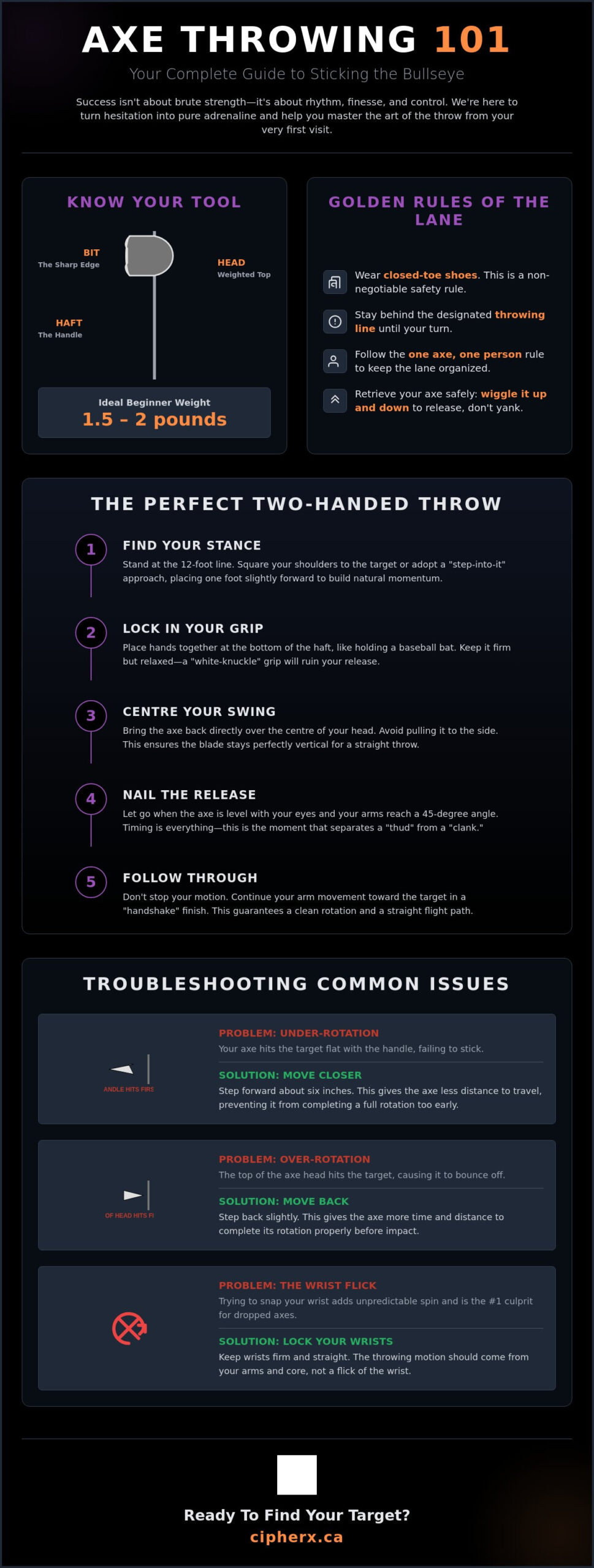
You don’t need a massive battleaxe to hit a bullseye. For those starting axe throwing for beginners, a tool weighing between 1.5 and 2 pounds is the sweet spot. It provides enough weight to stick in the target without wearing out your shoulder. Understanding the anatomy of your tool helps your grip. You have the bit (the sharp edge), the head (the weighted top), and the haft (the handle). Most beginner axes feature a wooden haft; this offers a natural feel and better shock absorption as you learn your release.
Step-by-Step: The Perfect Two-Handed Throw Technique
Success in the lane isn’t about raw power; it’s about balance. The two-handed overhead throw is the go-to method for axe throwing for beginners because it offers maximum stability. By using both arms, you eliminate the “wobble” that often happens with a one-handed toss. It allows you to engage your core and find a consistent rhythm. Think of your body as a pendulum. You want a smooth, repeatable motion that delivers the axe to the same spot every single time.
Start with your stance. You can either square your shoulders completely to the target or adopt a slight “step-into-it” approach. Stepping forward as you throw helps build natural momentum. For your grip, place your hands together at the bottom of the handle, much like you would hold a golf club or a baseball bat. Avoid “white-knuckling” the haft. A grip that is too tight prevents a clean release. Keep it firm but relaxed so the axe can slide out of your hands at the peak of the arc.
As you bring the axe back, keep it directly over the centre of your head. Do not pull it to the side of your ear. This ensures the blade stays perfectly vertical. If you’re planning a corporate booking, mastering this straight-line motion will make you the star of the office leaderboard.
The Release: Timing is Everything
Nailing the release is what separates a thud from a clank. You want to let go when the axe is level with your eyes. The release point is the moment your arms reach a 45-degree angle. Don’t stop your motion once the axe leaves your hands. Follow through with your arms extended toward the target in a “handshake” finish. This ensures the axe maintains its rotation and hits the wood bit-first.
Finding Your Distance
Most venues set the standard throw line at 12 feet, following the official WATL rules for competition. However, your height and arm length might require a bit of fine-tuning. If your axe hits the board flat with the handle, you are likely under-rotating. Move forward about six inches to give the blade more time to bite. If it hits the top of the head first, you are over-rotating. Step back slightly to find your sweet spot. Small adjustments lead to big scores.
Troubleshooting: Why Isn’t My Axe Sticking?
Nothing kills the vibe faster than the sound of steel clattering onto the floor. You expect a satisfying thud, but instead, you get a “clank” and a bounce. Don’t let it rattle you. Even the pros had to learn how to read the wood. The most important part of axe throwing for beginners is realizing that every miss is just data. You just need to know how to decode it.
The #1 culprit for a dropped axe is the “wrist flick.” Many people try to snap their wrist like they are throwing a ball. This adds too much unpredictable spin. Keep your wrists locked and firm. Your arms should act like a single, solid pendulum. If you find yourself flicking, take a second to reset. Focus on a smooth release where your palms finish facing the target.
Listen to the lane. A deep “thud” is the sound of victory. A high-pitched “clank” means you hit with the poll, which is the back of the head, or the handle. Stay calm and adjust your rhythm. If you’ve had a few drops, step back, breathe, and visualize the rotation before your next throw. Ready to test your technique? Book your axe throwing session and start sinking those blades.
Fixing Over-Rotation
If the top of the axe head hits the board first, you have over-rotated. The axe turned too much in the air. This usually means you are releasing the axe too late or standing too far from the board. To fix this, simply step forward toward the target by about six inches. This gives the blade less time to spin, ensuring the bit hits the wood while it is perfectly vertical.
Fixing Under-Rotation
If the handle hits the board before the blade, you have under-rotated. The axe didn’t have enough time to finish its flip. This is common if you are releasing too early. Take a small half-step back from the throw line. Giving the axe that extra bit of distance allows it to complete its rotation so the bit can bite into the wood.
Leveling Up: From First Throw to Bullseye Mastery
Once you have nailed the two-handed basics, it’s time to level up. Transitioning to a one-handed throw is a major milestone in axe throwing for beginners. It requires a bit more finesse but offers a satisfying release that feels incredibly natural. Focus on keeping your shoulder square and your eyes locked on the prize. Success here is about consistency. You aren’t just throwing; you are calculating. Every movement should feel deliberate and smooth.
You need to know how to score to win. The target is divided into distinct zones: the Bullseye earns you 6 points, the inner ring gives you 4, and the outer ring is worth 2. If you are feeling bold, aim for the “Killshot.” These are the small blue circles in the top corners. They are high-risk but offer maximum points, making them perfect for a last-minute comeback. This competitive edge is exactly why axe throwing is the ultimate choice for corporate team building in Coquitlam. It turns a standard afternoon into a legendary battle for office bragging rights.
Competitive Socializing and Leagues
Don’t stop at just one session. Turn your new skills into a full-blown hobby by joining an indoor axe throwing league in Coquitlam. The community is what makes the sport special. Social etiquette is key in the lanes. Cheer for “clutches” and high-five your opponents after a solid round. It is a place where every bullseye is celebrated by the whole room, creating a bond through shared adrenaline.
Booking Your First Session
Booking a lane for a birthday or staff party is the best way to practice with friends. You get to balance professional instruction with pure, unadulterated play. We organize the space so your group can focus on the targets. It’s about more than just the score; it’s about the memories made between the throws. If you’re looking to explore even more ways to beat the rain and keep your group energized, check out our guide to indoor recreation in Delta for even more high-energy options in 2026. Ready to test your aim? Book your axe throwing lane at CipherX today!
Step into the Lane and Claim Your Glory
You have the stance. You know the release. You realize that sinking a bullseye is less about muscle and more about finding your centre and trusting the rhythm. From mastering the two-handed overhead throw to troubleshooting those tricky rotations, you are now equipped with the essential tools for a successful first session. Axe throwing for beginners is an addictive blend of focus and adrenaline that turns a regular night out into a tactile, immersive adventure with your crew.
Don’t just read about the satisfying thud of the wood; come experience it yourself in a high-octane environment. Our professional Axe-perts are on-site at every lane to coach your technique, ensuring you feel confident and capable from your very first toss. We provide safe, controlled indoor lanes in Coquitlam and Delta, serving as the top-rated venue for unforgettable birthday parties and high-energy corporate events. Ready to make your mark and claim your glory? Book Your Beginner-Friendly Axe Throwing Session at CipherX and start your journey to bullseye mastery today. The target is waiting for you.
Frequently Asked Questions
Is axe throwing for beginners safe?
Yes, it is incredibly safe. Axe throwing for beginners is built on a foundation of strict lane protocols and professional coaching. Our Axe-perts monitor every throw to ensure everyone stays behind the buffer zone and follows the rules. You can focus on the adrenaline and the fun while we handle the meticulous safety details. It is a controlled environment designed to keep every guest protected while they play.
Do I need to be strong to throw an axe successfully?
No, brute strength is not required. You only need enough power to lift a 1.5 to 2-pound axe, which is the standard weight for most beginner tools. The satisfying thud comes from your technique and a clean release rather than how hard you throw. We have seen people of all sizes and ages master the lane by focusing on their rhythm and finding their centre.
What should I wear to an axe throwing session in BC?
Closed-toe shoes are a mandatory requirement for stepping into the lane in BC. Beyond that, wear comfortable layers that don’t restrict your shoulder or arm movement. Since you’ll be active and moving around the lane, choose breathable fabrics that allow you to reach over your head easily. Avoid anything too bulky or precious. You want to feel liberated and ready to move as you find your perfect throwing stance.
Can children or teenagers participate in axe throwing?
Yes, we love hosting younger adventurers. Children and teenagers can definitely join the fun, provided they have the focus to follow safety instructions and are accompanied by an adult. It is a popular choice for high-energy birthday parties where kids can be the hero of their own story. Our coaches provide extra guidance to ensure they handle the equipment safely while experiencing the thrill of their first bullseye.
How long does it take to learn the basic technique?
You can learn the basics of axe throwing for beginners in about 15 minutes. Our expert coaches spend the first part of your session teaching the two-handed overhead throw and helping you find your ideal distance from the target. Most people are hitting the board and scoring points by their third or fourth attempt. It is a fast-paced learning curve that gets you into the competition quickly.